



Winnie the Pooh and Personality Disorders
The stories of Winnie the Pooh are whimsical and beloved, yet many educators and psychologists have noticed that the characters exaggerate traits found in real life. Some reflect mental health conditions (like depression or anxiety), while others echo personality disorders (enduring patterns of thinking and behaving that can make life more difficult).
Of course, A.A. Milne never wrote them with psychology in mind—these interpretations are symbolic, not clinical. But they offer a lighthearted way to better understand complex conditions and to remind us that struggles don’t erase value.
This article blends humor with education. While these comparisons may help make mental health concepts easier to understand, they should never be used for self-diagnosis or as a substitute for professional care. If you are experiencing mental health challenges, please reach out to a therapist, counselor, or healthcare provider. Help is available, and you don’t have to walk through your Hundred Acre Wood alone.
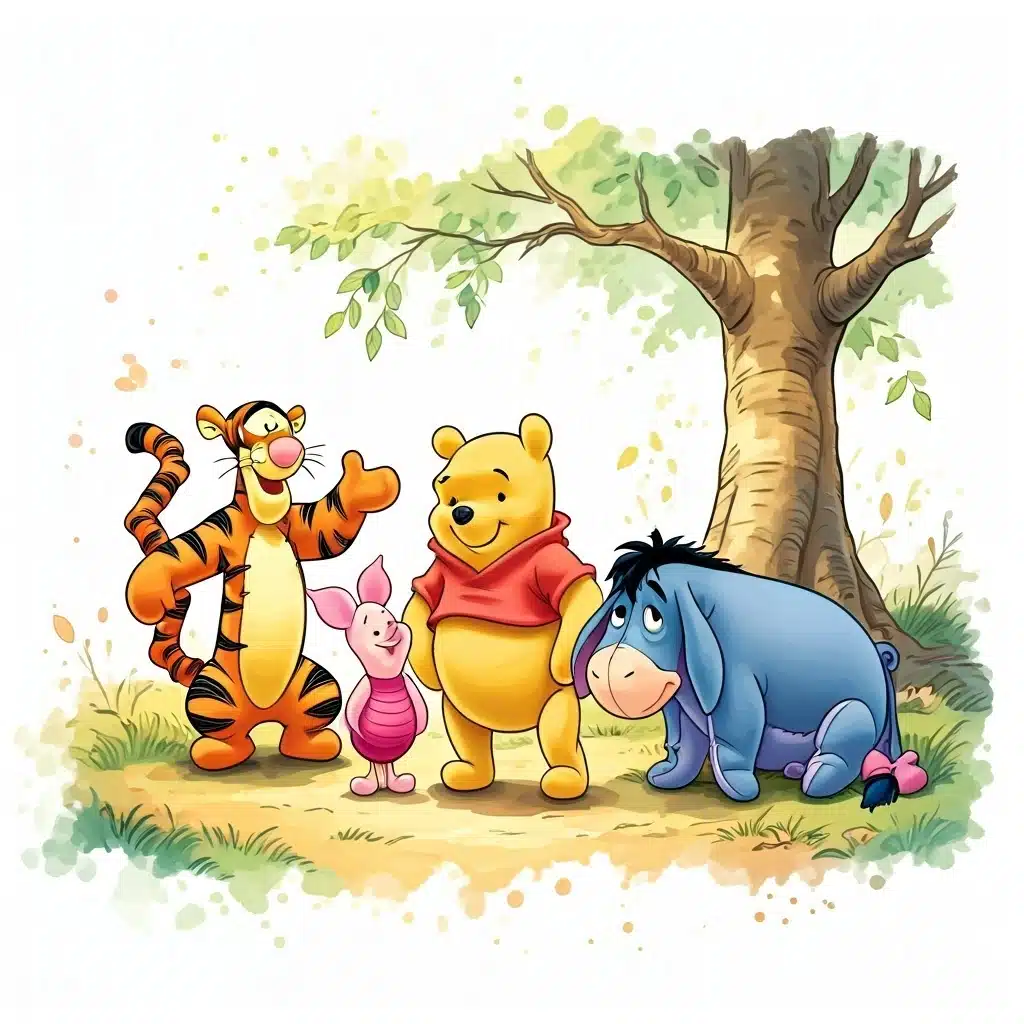
Winnie the Pooh – Attention Difficulties (ADD)?
In the stories: Pooh forgets what he’s doing, gets distracted easily, and hyper-focuses on honey.
Real-life connection: ADD can look like forgetfulness, zoning out during meetings, or difficulty organizing tasks.
Value: Pooh shows us that distractibility doesn’t erase warmth or loyalty. Tools like reminders, routines, and coaching can help.
Piglet – Avoidant Personality Disorder (Cluster C) / Anxiety Disorder?
In the stories: Piglet trembles, second-guesses, and avoids risks.
Real-life connection:
- Anxiety disorder: constant worry, restlessness, physical symptoms.
- Avoidant Personality Disorder: extreme shyness, fear of rejection, avoiding connection despite craving it.
Value: Piglet teaches us that sensitivity brings empathy. Therapy and gradual exposure can help reduce avoidance and fear.
Tigger – ADHD / Histrionic Personality Traits (Cluster B)?
In the stories: Tigger bounces into every situation, impulsively and dramatically.
Real-life connection:
- ADHD: impulsivity, hyperactivity, difficulty sitting still.
- Histrionic Personality Traits: craving attention, enthusiasm, emotional expressiveness.
Value: Tigger reminds us that energy is a gift—when channeled with balance.
Eeyore – Major Depressive Disorder / Dependent Personality Traits (Cluster C)?
In the stories: Eeyore expects disappointment and struggles to feel joy.
Real-life connection:
- Depression: sadness, hopelessness, low motivation.
- Dependent traits: needing reassurance, difficulty feeling secure alone.
Value: Eeyore shows that even sadness doesn’t erase belonging. Depression is treatable, and support makes a difference.
Rabbit – Obsessive-Compulsive Personality Disorder (Cluster C)?
In the stories: Rabbit craves order, rules, and control.
Real-life connection: OCPD involves perfectionism, rigidity, and needing things “just right.”
Value: Rabbit teaches us that structure is good—but flexibility creates peace.
Owl – Narcissistic Personality Traits (Cluster B)?
In the stories: Owl loves lecturing and considers himself the wisest.
Real-life connection: Narcissistic traits include exaggerated self-importance, craving admiration, and overlooking others’ needs.
Value: Confidence is helpful—but empathy completes wisdom.
Christopher Robin – The Caretaker / Dissociation?
In the stories: Christopher Robin guides his friends and may represent a child’s imagination coping with stress.
Real-life connection: Dissociation and fantasy can be coping strategies when reality feels overwhelming.
Value: Imagination can heal—but real-world support and connection are equally important.
FAQs About Personality Disorders and Mental Health
What is the difference between a mental health disorder and a personality disorder?
- A mental health disorder (like depression or anxiety) often appears episodically—it can improve, worsen, or resolve with treatment.
- A personality disorder is a long-standing, rigid pattern of thoughts, feelings, and behaviors that typically begins in adolescence or early adulthood and affects relationships, work, and self-image.
What are the types of personality disorders?
Personality disorders are grouped into three clusters in the DSM-5:
- Cluster A (odd/eccentric): Paranoid, Schizoid, Schizotypal.
- Cluster B (dramatic/emotional): Borderline, Histrionic, Narcissistic, Antisocial.
- Cluster C (anxious/fearful): Avoidant, Dependent, Obsessive-Compulsive Personality Disorder (OCPD).
Can someone have both a mental health disorder and a personality disorder?
Yes. For example, a person might live with both depression (mental health disorder) and borderline personality disorder (personality disorder). Treatment plans often address both together.
Are personality disorders treatable?
Yes. While personality disorders are enduring, therapy—especially cognitive-behavioral therapy (CBT) or dialectical behavior therapy (DBT)—helps people manage symptoms, improve relationships, and build healthier coping strategies.
How can I support a loved one with a personality disorder?
- Learn about their condition without judgment.
- Set healthy boundaries.
- Encourage professional help.
- Show patience and empathy, while remembering to care for yourself too.
Should I self-diagnose based on these examples?
No. The Pooh characters are a metaphor, not a diagnostic tool. If you see yourself in Piglet’s worry or Rabbit’s rigidity, it’s simply an opportunity to reflect. For an accurate assessment, seek guidance from a licensed mental health professional.


This article is for educational purposes only. It uses the beloved characters of Winnie the Pooh in a lighthearted, metaphorical way to make complex mental health and personality disorder concepts more approachable. These interpretations are not clinical diagnoses, and A.A. Milne did not create his characters with psychology in mind.
The playful comparisons are intended to raise awareness and spark discussion, not to minimize the seriousness of mental health or personality disorders. Some readers may find the sense of humor helpful, while others may feel it oversimplifies. If you or someone you know is struggling, please seek guidance from a licensed mental health professional.
Published: July 01, 2025
Last Updated: August 24, 2025




Published: April 01, 2026
IOP for OCD in Los Angeles, California
Summary: An intensive outpatient program (IOP) for OCD provides structured, evidence-based treatment several hours per day, multiple days per week, specifically designed for individuals whose OCD symptoms are moderate to severe and have not responded adequately to weekly therapy alone. IOP delivers the frequency of Exposure and Response Prevention (ERP) practice that OCD treatment requires […]
Read more
Published: March 24, 2026
ERP Therapy for OCD: How Exposure and Response Prevention Works
Summary: Exposure and Response Prevention (ERP) is the most effective evidence-based psychotherapy for obsessive-compulsive disorder. Unlike general talk therapy or standard CBT, ERP specifically targets the obsession-compulsion cycle by systematically exposing patients to the thoughts, images, situations, or objects that trigger their obsessions while helping them resist performing the compulsive behavior or mental ritual that […]
Read more
Published: March 06, 2026
Pure O OCD: Symptoms, Mental Compulsions, and Treatment in Los Angeles
Summary: Pure O OCD (purely obsessional obsessive-compulsive disorder) is a widely used term describing a presentation of OCD in which compulsions are primarily internal (mental rituals, rumination, reassurance-seeking, mental reviewing) rather than visible physical behaviors like hand-washing or checking. Despite the name, Pure O is not truly “purely obsessional.” Research consistently shows that individuals with […]
Read more